How to Choose a Flexible Circuit Board Coater for Your Needs?
Selecting the right Flexible Circuit Board Coater is crucial for your manufacturing needs. This choice impacts the efficiency and quality of your production process. The market offers various options, making it challenging to identify the ideal one for your specific applications.
Consider the type of coatings you need. Certain coaters specialize in specific materials, while others provide broader options. Think deeply about your production volume as well. A high-volume operation may require a different type of coater than a small batch production line. Don't overlook the operational costs associated with different models, as these can significantly affect your bottom line.
Researching user reviews and feedback is essential. Many coaters may appear effective but can disappoint in practice. It's common to find some models with inconsistent results. Be prepared to test different coaters to find the perfect fit for your needs. Ultimately, choosing a Flexible Circuit Board Coater involves careful consideration and reflection on your unique requirements.

Understanding Flexible Circuit Board Coating: Basics and Benefits
Flexible circuit boards are essential in modern electronics. They offer numerous advantages, including lightweight design and compact configurations. Coating these circuits enhances durability and performance. A well-applied coating can significantly protect against moisture, dust, and mechanical stress.
Research indicates that flexible circuit boards are expected to witness a compound annual growth rate (CAGR) of 12.8% from 2023 to 2028. This growth is driven by increasing demand in sectors like automotive and medical devices. The coating not only improves the longevity but can also boost efficiency by ensuring better electrical insulation and adhesion. Manufacturers need to balance adaptability and cost-effectiveness when selecting a coating type.
**Tip:** Evaluate the specific requirements of your application. Whether you need conformal coating or encapsulation, the choice should align with environmental conditions.
Selecting the right coating also poses challenges. Different materials respond uniquely to various coatings. This inconsistency can lead to performance issues. Conducting thorough testing is crucial.
**Tip:** Always request samples to assess the coating’s real-world performance. Real case scenarios may vary from expected outcomes.
Flexible Circuit Board Coating Benefits
Evaluating Coater Performance: Throughput and Efficiency Standards
When selecting a flexible circuit board coater, focus on throughput and efficiency. These factors significantly impact production. According to industry reports, a high-performing coater can achieve throughput rates exceeding 70%. Yet, many facilities fall short, often reaching only 50-60%. This difference can affect overall production timelines and costs.
Tip: Assess your specific production needs before making a choice. Do you prioritize speed or precision? Weigh the importance of efficiency against the demands of your production scale. Coaters that promise rapid throughput may sacrifice precision. In some cases, a slower option may yield better results overall.
Efficiency standards are equally important. Manufacturers often use terms like "yield rate" to indicate the proportion of defect-free products. Ideal yield rates are above 95%. However, many operations encounter issues that drop this percentage significantly. Regular maintenance can improve both yield and throughput.
Tip: Monitor your coater's performance regularly. Ensure calibration and cleaning schedules are followed. Minor discrepancies in performance can lead to substantial losses over time. A culture of continuous improvement will keep your production line competitive.
How to Choose a Flexible Circuit Board Coater for Your Needs?
| Coater Type |
Throughput (m²/h) |
Efficiency (%) |
Coating Thickness (μm) |
Setup Time (min) |
| Automatic Coater |
25 |
95 |
10-200 |
15 |
| Semi-Automatic Coater |
15 |
90 |
20-150 |
30 |
| Manual Coater |
5 |
85 |
30-100 |
60 |
| Roll-to-Roll Coater |
30 |
92 |
5-50 |
45 |
Material Compatibility: Choosing the Right Coating for Your PCB
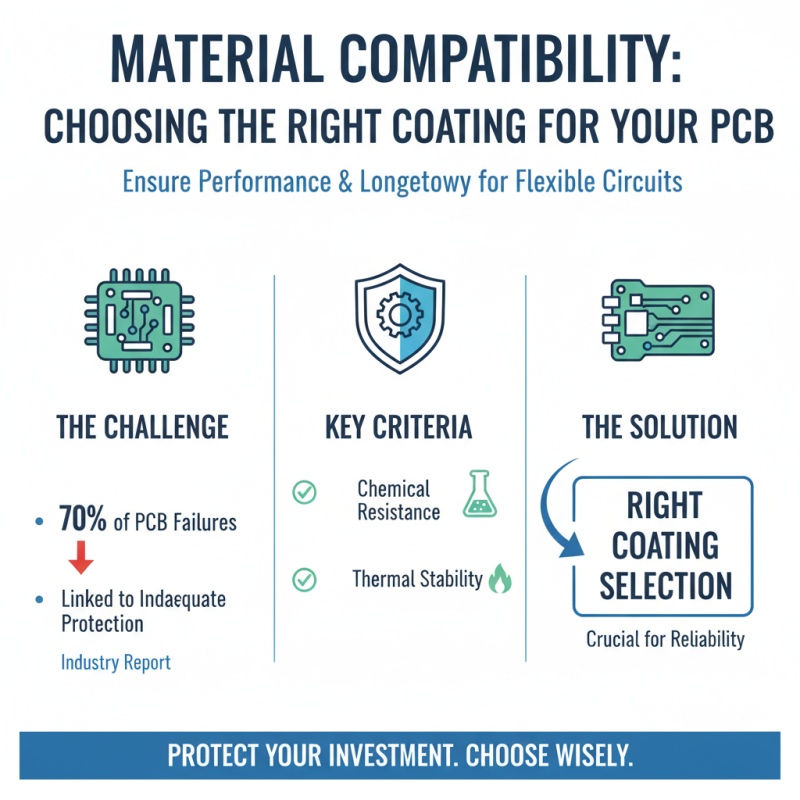
Choosing the right coating for your flexible circuit boards (PCBs) is crucial. Material compatibility plays a significant role in ensuring performance and longevity. According to a recent industry report, approximately 70% of failures in PCBs are linked to inadequate protection of the underlying materials. This emphasizes the need for coatings that are chemically resistant and thermally stable.
Flexible circuit boards often face harsh conditions. Therefore, selecting a coating that can withstand moisture and chemical exposure is vital. For instance, polyimide coatings are popular due to their excellent thermal properties. These coatings can endure extreme temperatures, making them suitable for a variety of applications. However, they may not be compatible with all substrates, which can lead to delamination.
Environmental concerns are also essential. Some coatings contain components harmful to the environment. Understanding the properties of potential coatings can help manufacturers choose wisely. A recent study indicated that eco-friendly coatings are increasingly favored, with 45% of companies planning to switch in the next year. Thus, selecting a coating that balances performance and environmental impact is no easy task. The quest for the right material is ongoing.
Cost Analysis: Budgeting for a Flexible Circuit Board Coater
When budgeting for a flexible circuit board coater, consider several key factors. Equipment costs can vary widely. You need to evaluate the coating technology. Some options may be less reliable. Others may have high precision but come with a steep price tag.
Consider operational costs too. Supplies, maintenance, and energy consumption can add up over time. Is the performance worth the investment? Research can reveal hidden costs not initially apparent. You may find that cheaper models have higher failure rates. This leads to costly repairs and downtime.
Finally, don’t overlook the potential for scaling. If your production needs grow, will the coater still meet demands? A smaller machine may save money now but could limit future growth. Balancing initial investment with long-term needs is crucial. Inadequate planning may lead to regrets. Reflect on your choices and their long-term impacts.